


LightSpun was building a system to verify whether health care providers were properly licensed when one result did not make sense.
A handwritten application pointed to Washington. The system returned a license from Minnesota.
An AI agent had misread the state and searched the wrong source. LightSpun’s internal quality team caught the mistake before it reached a customer, but the error immediately changed how Deepak Ramaswamy, the company’s co-founder and CTO, thought about the product.
A wrong answer in this setting is more than an inconvenience. It could lead an insurer to approve the wrong provider, deny the right one or use incorrect information in a payment or patient communication. The model had completed the task confidently. It had also completed it incorrectly.
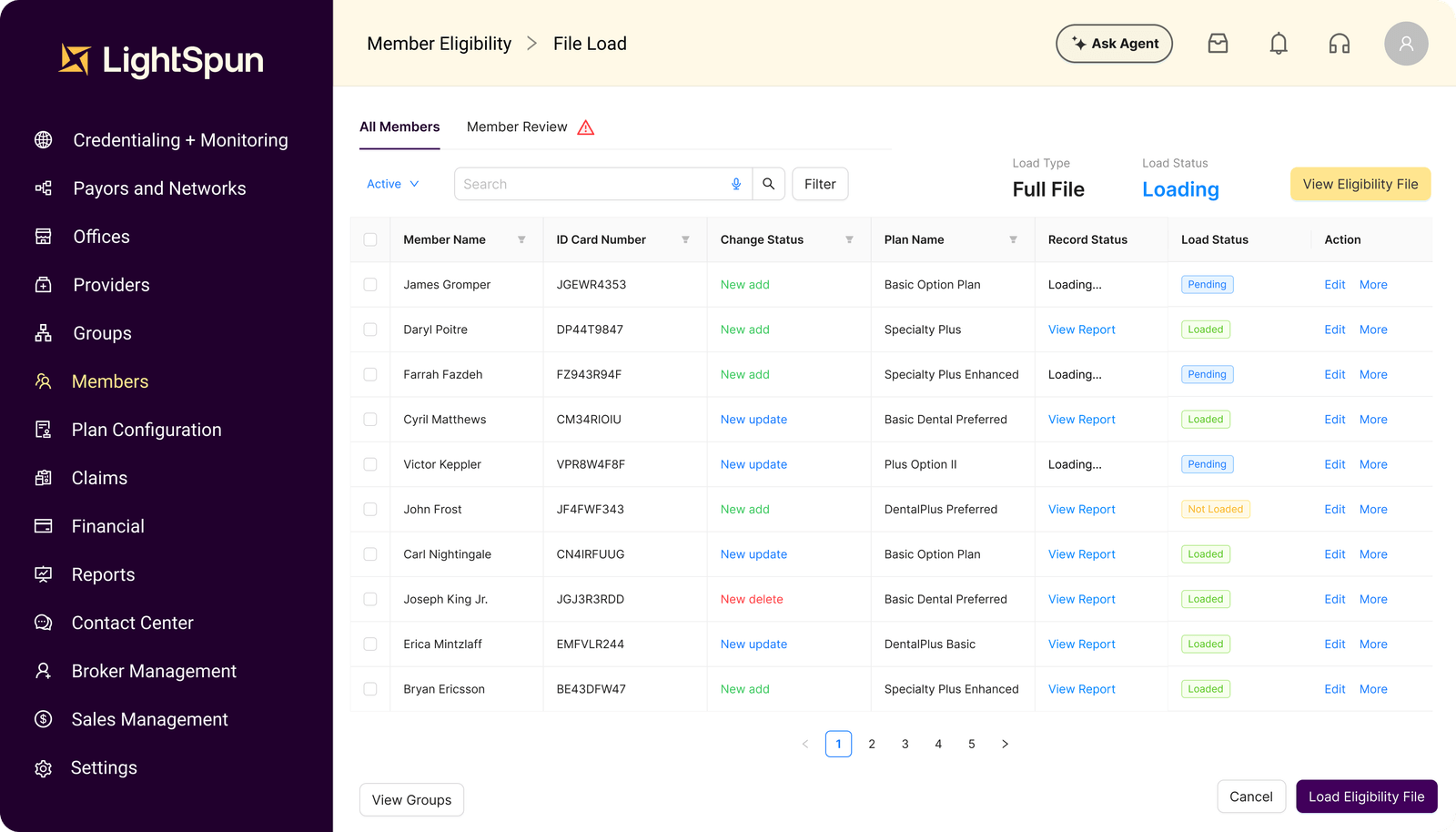
LightSpun now routes AI-generated credentialing work through a staging area before it enters a customer-facing process. A person reviews the result, and then a system also compares information across sources and lowers its confidence when the details conflict.
That decision captures how Deepak approaches AI more broadly. LightSpun uses agents throughout its engineering organization, but it does not assume that more AI produces a better system.
Still Single Threaded
AI has removed some of the old boundaries inside LightSpun.
Product managers can inspect code without waiting for an engineer to explain it. Deepak’s co-founder, Shaju Puthussery, can arrive at a meeting with five or six working interface concepts instead of describing what he wants built. Engineers can use agents to work across parts of the software stack that once sat outside their specialties.
Deepak can run five or six agents at the same time. One might search for data-quality problems. Another might investigate an issue before a customer finds it. A third might help work through a complicated migration.
The work moves faster, but it doesn’t disappear. Every result still needs someone to decide whether it is correct, useful and worth acting on.
“The person is still single threaded,” Deepak said.
His workload has increased as the company has adopted more AI, even as LightSpun has hired and added management structure. His team can now generate more code, analysis and prototypes at once. The limiting factor is no longer the ability to produce the work. It is the ability to judge it.
LightSpun has made agents part of how it evaluates engineering performance. Engineers are expected to build, maintain and use them in their daily work. The company wants AI to become part of the operating system of the team rather than remain a side experiment. But, that only works if the company is equally deliberate about the places where an agent should not make the final decision.
A Model Has to Earn Its Place
Deepak reviews a financial dashboard that tracks LightSpun’s token consumption. When the number jumps, he wants to know what happened.
The question is not whether AI is expensive in the abstract. The work still has to be completed. LightSpun could hire someone, build traditional software or use a model. Deepak compares those options based on frequency, cost and risk.
For common tasks, the company gives agents defined routes through the work. If someone needs to understand the history of an insurance claim, an internal agent can follow the sequence of events and identify what happened at each stage. It does not have to rediscover the process every time.
Other tasks do not require a model at all. Claims processing often needs to produce the same result when the same conditions are present. Compliance also requires a record of how the decision was made. AI can help engineers create and test the code, but the final pathway can remain deterministic.
“You don’t want to spend tokens on deterministic pathways,” Deepak said.
LightSpun uses less expensive models to coordinate work and saves more capable models for problems that require deeper analysis. It has also evaluated open-weight models, which could give the company more control and reduce its dependence on hosted providers.
Deepak has not yet seen enough benefit to justify pulling a small engineering team away from customer problems. A model used in 10% of claims may not justify the time required to fine-tune and maintain it. However, one involved in 80% of claims might.
When evaluating technology, restraint matters because the barrier to using AI has fallen so quickly. Determining what context the model receives, how its work is checked and where the company chooses to replace judgement with fixed rules becomes the primary consideration.
When the Fax is Still Relevant
Deepak applies the same thinking to the insurance systems LightSpun is trying to replace.
A dental claim can still begin with a provider filling out a paper form and mailing it to an insurance company. Someone scans it. Another person verifies that the information was digitized correctly. The claim moves through additional systems for processing and payment.
Even fax numbers remain important because they can be more reliable than a provider’s email address or phone number.
These processes became complicated gradually. A simple workflow gained exceptions, manual reviews and specialized tools over decades. Each point solution improved one step while leaving the larger chain intact.
LightSpun began with a narrow product for configuring benefit plans. Customers found it useful, then pointed to the problems around it. Providers still had to be credentialed. Claims still passed through disconnected systems. Improving one part did not remove the delays elsewhere.
The company began building a shared data model across benefit configuration, credentialing and claims processing. That broader foundation is now allowing LightSpun to work with a financial-services partner on near-real-time payments for dentists.
Today, a dentist may complete a procedure, submit a claim and wait weeks to be paid. The practice may follow up or resubmit the claim because it does not know where the payment stands. The patient may not learn what the plan covered until a bill arrives later.
The system LightSpun is building would connect the coverage decision more closely to the visit, allowing the provider to confirm what is covered and receive payment much sooner.
That outcome depends on more than moving money faster. The provider must already be credentialed. The benefit plan must be configured correctly. The claim has to follow rules the insurer can explain and audit.
It's the same discipline that once caught a license from the wrong state, a system built to notice when an answer looks right but isn't. LightSpun now runs that discipline through an entire chain, not just a single check. The model that confused Washington with Minnesota did exactly what it was asked. Catching what it couldn't, is still a human job.
More from Uncovered Media


