


When Mux spent years building clean, predictable APIs for human developers, nobody on the engineering team was designing for machines. They were solving a narrower problem: making video infrastructure simple enough that a developer without deep video expertise could get a stream live and scale it globally without stitching together a dozen brittle components. The documentation was clear and the API contracts were consistent. Developer experience was the product.
Then large language models arrived, and something unexpected happened. Agents started picking up Mux’s APIs the same way human developers had, no major redesign required. This infrastructure, meticulously built for people, turned out to be exactly what machines needed, too. Ryan Grothouse, Mux’s VP Engineering & Product, has a theory as to why:
“Our API contracts are very clean and predictable. Agents are going to be more likely to want to pick those things up if they’re discoverable through our documentation. Agents have a path by which they can learn those things just the same as human developers.”
But Ryan understands that this compatibility is a window of opportunity; likely a fleeting one. Data formats and contracts will eventually need to be reshaped for agents. A decade of deliberate developer-experience work that translated, surprisingly natural, into an AI-ready infrastructure layer.
“Clean contracts got us a head start with LLMs. But the shape of the consumer keeps changing; from developers, to developers working with agents, to agents talking directly to agents. Each step, we have to evolve what we're building for. The head start only matters if we keep evolving.
Meet Ryan Grothouse
Ryan came up in the technical world through infrastructure engineering. His formative years were spent on cloud, DevOps, and platform work.
He joined Mux about five and a half years ago, coming from the consumer side of video rather than the infrastructure side. In his previous role at USA Today, he was a potential customer of a company like Mux, building video products for audiences rather than building the underlying pipes. His transition to building more foundational video infrastructure included a steep learning curve. “It’s a surprisingly complex task,” he says of the technical challenges behind playing video online.
Mux’s mission since its founding in 2015 has been to democratize video on the internet. That means handling ingestion, storage, transcoding, and delivery so that engineers at customer companies don’t have to become video experts to ship a streaming product. Transcoding (compressing a raw video file and repackaging it for delivery across every device type and network condition) sits at the center of that work. Mux’s system handles it in near real-time. Upload a five-second clip or a five-hour broadcast, and playback begins almost immediately.

Infrastructure Meets Agentic World
Ryan’s biggest open question looks beyond Mux’s current infrastructure work. What does video mean in a world where machines are becoming consumers alongside humans?
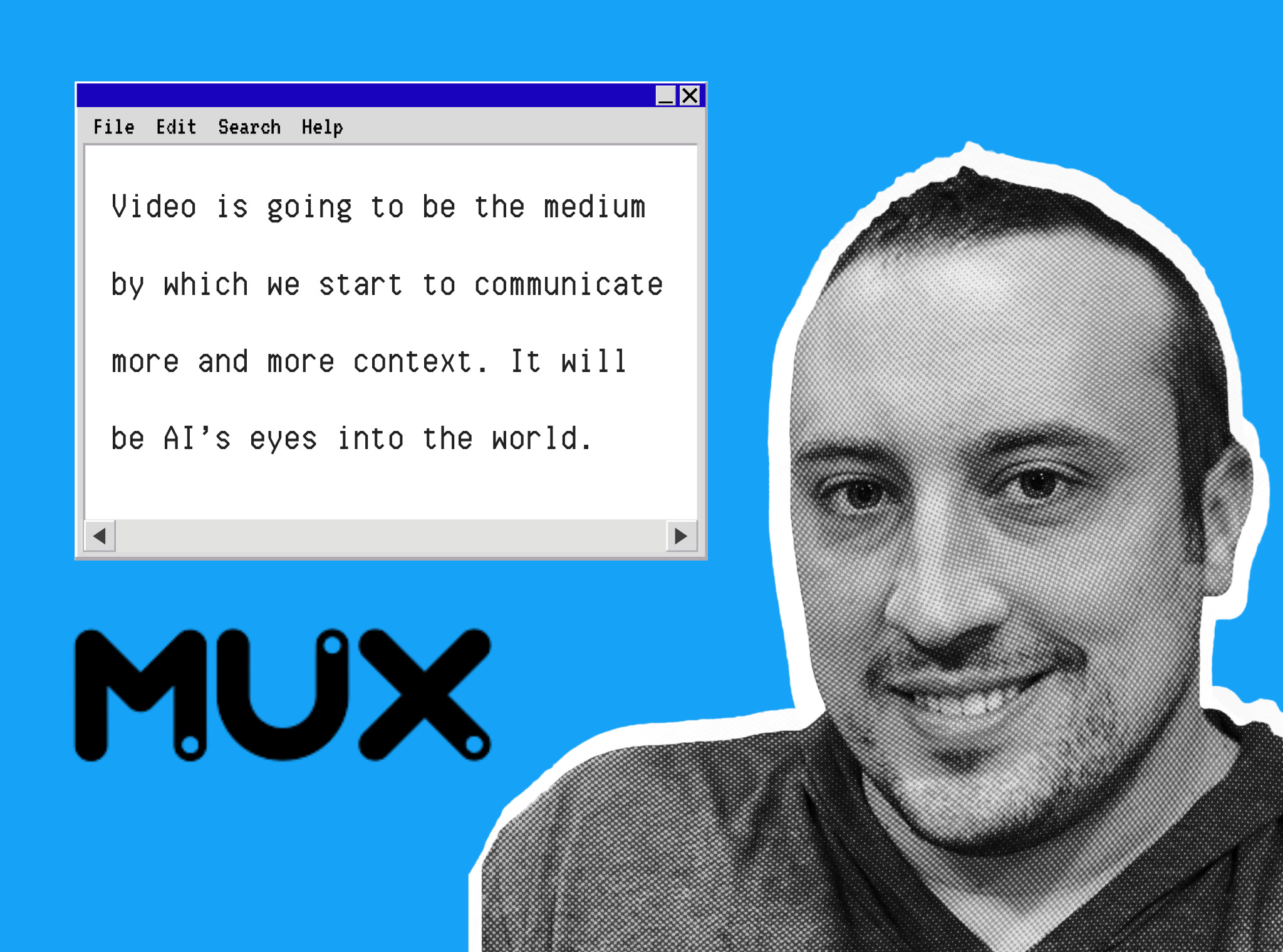
“I personally believe that for agentic workloads, video is going to be the medium by which we start to communicate more and more of that context. It will be AI’s eyes into the world.”
According to Ryan, video is the highest-bandwidth channel available for communicating context. A two-hour film can convey what thousands of pages of text cannot: not because one format is better than the other in absolute terms, but because motion, audio, image, and word all arrive simultaneously. For AI systems that need to understand the world at scale and at speed, video is the logical medium.
“Knowing that the rate at which machines are able to consume content continuously, I think it’s reasonable to believe that machines will consume orders of magnitude more video with time than even humans are able to consume.”
Ryan is careful about specifics on the current human-to-machine consumption ratio. But his prediction is structurally sound: Humans sleep, tire, and scroll to shorter formats. Machines consume continuously.
Mux’s infrastructure serves many millions of concurrent viewers on a single live stream and manages many hundreds of thousands of streams throughout a given week. Scaling that globally, across a noisy and inconsistent internet, is not a problem that can be solved by writing code faster with AI assistance. It requires infrastructure expertise that accumulates over years.
“At least as of now, this is one thing that AI has not yet been able to figure out: how to scale from an infrastructure perspective to serve many millions of viewers of concurrent viewership,” he says. That gap is part of Mux’s moat.
Mux’s Five-Layer Execution Model
On the internal engineering side, Ryan and his head of platforms built a five-layer model to track how AI adoption is evolving inside the organization. The layers move from traditional single-engineer development at the base, through AI-assisted coding, into what they call the “engineer as manager” model at layer three. Above that sits more automated workflow orchestration, and at the top, fully autonomous systems with human oversight at the edges.
Mux is currently operating at layer three. Engineers are running multiple agents in parallel, acting as orchestrators rather than individual code writers. The job description, Ryan explains, has shifted from knowing a coding language and writing logic directly, to developing specifications, context, and design documents that another entity (human or agent) can pick up and execute.
“It’s really about how… [to] develop the context and the systems that allow another entity to be able to develop this. Not unlike what engineering managers or even product managers historically have spent their time on.”
In Ryan’s personal workflow, he uses Claude alongside Notion, deliberately designing outputs so they feed back into the organization as inputs others can use. His colleagues’ agents have started picking up content that his agents produced, creating a feedback loop that nobody explicitly architected. If he needs something, someone else in the organization probably needs it too. Making that output discoverable across the organization multiplies its value without multiplying the work.
Cattle vs Pets for Code
A defining metaphor that shaped Ryan’s thinking came from an article that connects his infrastructure background to the present AI . “Cattle vs. Pets” spread as a meme in the early 2010s in relation to cloud computing.
In September 2016, Randy Bias shared the elevator pitch for this analogy in a clarifying article:
In the old way of doing things, we treat our servers like pets, for example Bob the mail server. If Bob goes down, it’s all hands on deck. The CEO can’t get his email and it’s the end of the world. In the new way, servers are numbered, like cattle in a herd. For example, www001 to www100. When one server goes down, it’s… replaced.
Ryan Madden summarizes the history in his September 2025 article extending the metaphor to code:
In the 2010s, cloud computing enabled a new way of managing servers famously characterized as ‘cattle, not pets’. The ability to cheaply and efficiently provision and release compute resources created a paradigm shift: servers which were once discrete, expensive, and carefully-managed physical resources became disposable, interchangeable abstractions managed at arms-length.
In 2025, LLMs seem poised to deliver a similar revolution for code. Many software engineering practices are downstream of the assumption that code is expensive to create and manage. As the cost of code generation craters, powerful and efficient new ways of working are suddenly possible. What tools, systems, and practices will be necessary to enable the ‘cattle, not pets’ paradigm for code? And what practical roadblocks exist to building software in this way?
From his seat at Mux, Ryan concurs.
What AI is beginning to do for development is what the cloud did for infrastructure 10 to 12 years ago. Back then we stopped treating servers as precious, hand-tended things and started treating them as disposable and interchangeable. Code is heading down that same path. Cheap enough to generate that you stop preserving it and start treating it as disposable. The durable asset moves up the stack.
The Role of Video in an Agentic Future
As AI makes video creation cheaper and faster, the volume of content on the internet is growing at a pace that outstrips anyone’s ability to evaluate it. Ryan’s view is that quality content wins in the long run. “I think people can see through some of the AI slop pretty quickly and can get pretty desensitized,” he says. The more pressing challenge is not so much an issue of bad content existing, but a problem of sheer volume making good content harder to surface.
“The real risk… is finding the signal from the noise. Where is that quality content, versus the explosion of additional content being created? That is really the challenge with the current dynamic.”
For Mux, that challenge points at where the company is going next. Surfacing signal means understanding what’s actually inside a video, not just delivering it reliably. The team is building beyond ingestion and delivery toward video intelligence and making video legible not just to the people watching it, but to the machines that increasingly are. If video becomes the medium through which agents understand the world, then the infrastructure can’t stop at moving pixels reliably; it has to make the content inside those pixels searchable, structured, and usable for use cases we haven’t thought of yet. Video becomes a workable asset.
It’s a problem where Mux’s position is unusual: the company already sits on performance and engagement data across a wide slice of the internet’s video traffic, and it already moves the video itself. Ryan says:
“Video for AI isn’t a feature you bolt on. It’s a foundation. We made video simple for developers over the last decade; the next chapter is making it usable for agents. The companies that win won’t be the ones who guessed the use case — they’ll be the ones whose infrastructure was ready when it showed up.”
What that becomes is a story still being written, but the through-line, from clean APIs to an agent-ready platform, is no accident.
More from Uncovered Media


